In front of xUML services we have the service client followed by the service itself. Thus, components serving these clients are called frontend components or frontend services. These frontend services can be further grouped into a logical deployment unit called composite. This is done in the component diagram.
The most simple component diagram is depicted below. It contains a <<E2EComposite>> component. This component is the deployment unit of a set of service components. Each <<E2EComposite>> component may contain several services. The different service types are described in the Service Implementations section, e.g. SOAP, HTTP, JMS, Java, Timer, Scheduler, SAPRFC, etc. Finally, each service contains at least one class realizing the service. For example, SOAP services contain SOAP port types.
This is the component diagram of the HelloWorldExample.
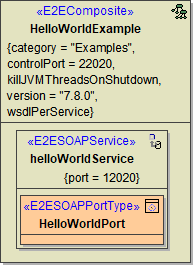
Each composite manifests itself as repository file after compilation. This means, after compilation the <projectPath>/repository folder contains the repository file HelloWorldExample.rep. Additionally, each of the logical components can be configured by the use of tagged values. This repository belongs to category Examples and uses a control port 22020. For further composite attributes see the table below.
After deployment, each composite is started as operating system process. More details about this architecture can be found in Bridge Architecture.
<<E2EComposite>> Attributes
The composite holds the following tagged values:
| Attribute | Type | Description | Allowed Values / Example | |
|---|---|---|---|---|
| Name | String | Name of the composite. |
HelloWorldExample |
|
| Version
(version) |
String |
A service version number. This service version is visible in service context on the Bridge. |
7.8.0 |
|
| ControlPort
(controlPort) |
Integer | Port used by the Bridge to control this xUML service. |
22020 |
|
| Category
(category) |
String |
Optional category to group similar xUML services. |
Examples |
|
| Node Type
(nodeType) |
String | Not used, leave empty. |
|
|
| External Test Proxy Host
(externalTestProxyHost) |
String |
Specifies the host name as seen by the client.
|
scheer-acme.com |
|
| Class To XML Default Root Name
(classToXMLDefaultRootName) |
String |
Bridge 7 Specify which name to assign to the XML root element upon serializing. This setting can be overridden by using XML composer options as described on classToXML() Operation. Refer to XML - UML Class Mapping for more information on the topic of XML serialization. |
Default |
Try to use name and namespace defined on the class by the <<XML>> stereotype. Fallback to Variable Name if not provided (default). |
| Type Name |
Use static name and namespace of the class as name of XML root element. |
|||
| Variable Name |
Use the name of the reference (object/variable) as name of XML root element. |
|||
| HTTP | ||||
| Http Header Roles
(httpHeaderRoles) |
Array of String |
Builder 7.12.0 Runtime 2020.12 In the context of HTTP based services (HTTP, REST, SOAP), assign roles to dedicated incoming headers that define how the related header will be treated by the xUML Runtime. These definitions overwrite the default behavior, and X-Transaction-Id, X-Request-Id, X-Sender-Host and/or X-Sender-Service will be substituted by this definition. Refer to HTTP Header Support > Overwriting the Standard HTTP Headers for more details. Http Header Roles can hold a list of definitions in format |
client_host | Take the sender host from header <http header name> instead of X-Sender-Host. |
| client_service | Take the sender service from header <http header name> instead of X-Sender-Service. |
|||
| correlation_id | Take the correlation ID from header <http header name> instead of X-Request-Id. |
|||
| transaction_id | Take the transaction ID from header <http header name> instead of X-Transaction-Id. |
|||
| Request Http Header Roles
(requestHttpHeaderRoles) |
Array of String |
Builder 7.12.0 Runtime 2020.12 In the context of HTTP based adapters (URL, REST, SOAP), enable automatic header generation for the listed headers. These definitions overwrite the default behavior, and X-Transaction-Id, X-Request-Id, X-Sender-Host and/or X-Sender-Service will be substituted by this definition. requestHttpHeaderRoles can hold a list of definitions in format |
client_host | Provide the client host in a header <http header name> instead of X-Sender-Host. |
| client_service | Provide the client service in a header <http header name> instead of X-Sender-Service. |
|||
| correlation_id | Provide the correlation ID in a header <http header name> instead of X-Request-Id. |
|||
| transaction_id | Provide the transaction ID in a header <http header name> instead of X-Transaction-Id. |
|||
| passthrough | Pass a present header <http header name> to the called service. |
|||
passthrough= <request header name> |
Pass an incoming header <request header name> to the called service under the name of <http header name>.
This is equivalent to renaming a header. |
|||
| JVM | ||||
| Read Modeling the Java Components for more information on these tagged values. | ||||
| Persistent State | ||||
| Read Persistent State Components for more information on these tagged values. | ||||
| SAP | ||||
| SAP Default Connection Pool Size
(sapDefaultConnectionPoolSize) |
Integer |
Default capacity of a single SAP connection pool (Bridge acting as a SAP client). If undefined, a default of 10 connections will be applied.
You can override the connection pool size for a specific connection on the corresponding SAP alias. On using dynamic SAP access, the default connection pool size is used. |
a valid integer, default is 10 | |
| SAP Padding
(sapPadding) |
String |
Service-wide setting for SAP values padding. This setting will be applied to all IDoc and SAP adapters within the service. It is not recommended to use Mixed padding. This option is only available for reasons of backwards compatibility. Mixed padding is default for older services that have been compiled before the implementation of this tagged value, whereas Never is default, if no SAP padding is specified. |
Never | No padding, removes existing padding (default). |
| Always | Always pad to specified length. | |||
| Mixed | Padding only fields that are not within deep structures. | |||
| SAP Server Worker Threads
(sapServerWorkerThreads) |
Integer |
Number of parallel request (workers) the Bridge (acting as an RFC server) can process. If this value is undefined, the Bridge will only process one request at a time (equivalent to sapServerWorkerThreads=1). Each active worker requires one license slot (concurrent connection). For more information on licensing and concurrent connections, refer to License for Running xUML Services. |
a valid integer, default is 1 | |
| Startup/Shutdown | ||||
| Startup Shutdown Trace Port
(startupShutdownTracePort) |
Integer |
Default port for tracing startup or shutdown activities is 30000. You can change this default here, if necessary. |
||
| Startup Activity
(startupActivity) |
Reference to Activity | The referenced activity is called while starting up before any other component gets invoked - including timers and schedulers. | ||
| Shutdown Activity
(shutdownActivity) |
Reference to Activity | The referenced activity is called when the xUML Runtime is being shutdown. | ||
| Startup Must Succeed
(startupMustSucceed) |
Boolean |
Runtime 2021.9 The service does not start if the implemented startup activity fails. |
true | The service does not start if the startup activity fails. |
| false | The service starts although the startup activity fails (default). | |||
| Test | ||||
| Read Using Testable Classes for more information on these tagged values. | ||||
| WSDL | ||||
| WSDL Per Service
(wsdlPerService) |
Boolean |
If true (default=false), each xUML service gets its own WSDL file. Additionally, all XML Schema elements and types having the same namespace are put into one schema file. These schema files are imported into the WSDLs to be shared among them. In this case it is also possible to mix RPC/soap-encoded services with Document/literal services. |
||
| WSDL Namespace
(wsdlNamespace) |
String |
Target WSDL namespace of the generated WSDL file. Relevant only, if wsdlPerService is false (this is the default). |
||
| Soap Version
(soapVersion) |
String |
Specify the version of the SOAP protocol you want to use with the service. |
1.1 | SOAP version 1.1 (default) |
| 1.2 | SOAP version 1.2 | |||
| Resolve Inheritance
(resolveInheritance) |
Boolean |
If true, the inheritance hierarchy is resolved into flat messages. As of Bridge 7, setting resolveInheritance to true is deprecated, because this will generate a different output structure than modeled. It also has hidden requirements to the element uniqueness. |
false | Keep inheritance hierarchy. (Bridge 7 default) |
| true | Resolve inheritance hierarchy into flat messages. (before Bridge 7 default) | |||
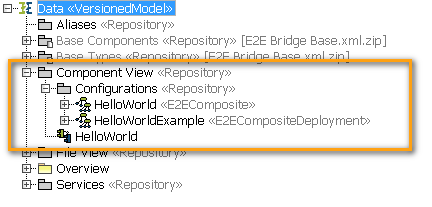
The component diagrams, the composites, and services artifacts are always found in the same place in all UML models:
Figure: Component View in the Containment Tree