
This page explains the Flat File Adapter in Bridge context. If you were looking for the same information regarding the PAS Designer, refer to Flat File Adapter in the Designer guide.
Defining the Flat File
The flat file structure is defined in a class diagram. A root class defines the file and its settings (like e.g. the record separator). This class must have stereotype <<FlatFile>>.
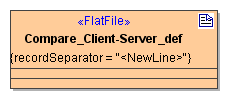
As this is the root of a flat file declaration no attributes are allowed. You should give this class a meaningful name, because the output object flow of the <<FlatFileAdapter>> action in the activity diagram uses this class as a type.
You can change the flat file settings on the specification dialog of the root class.
Figure: Change Flat File Settings
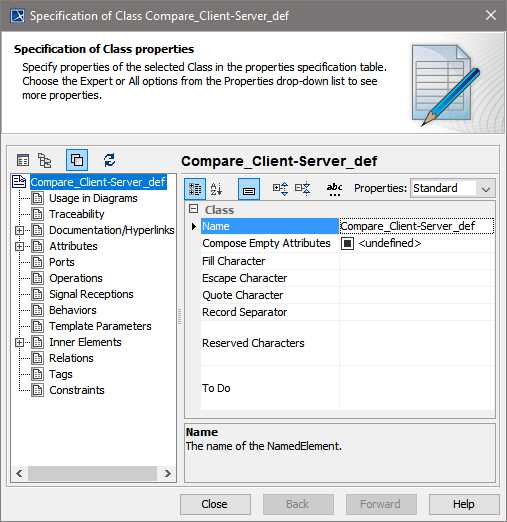
Value <NewLine> of tag Record Separator is a literal placeholder for special character \n. A complete list of all placeholders is listed below.
|
Placeholder |
C Syntax |
Character (Dec.) |
|---|---|---|
|
|
|
9 |
|
|
|
10 |
|
|
|
13, 10 |
|
|
|
27 |
|
|
|
32 |
The other optional tagged values are listed below.
Flat File Settings
Find below a list of all tagged values corresponding to stereotype <<FlatFile>>.
| Tagged Value | Description | Allowed Values | Example | |
|---|---|---|---|---|
| escapeCharacter | Defines the character used for escaping when a reserved character is used within a field value. | any character | / |
|
| fillCharacter | Defines a dummy character to fill non-existent values (results in NULL). Used for fixed attribute layout only. | any character | 0 |
|
| quoteCharacter | The quoteCharacter will be ignored by reading field value. | any character | / |
|
| recordSeparator | Separator of the different records, normally line feed and carriage return. For serialized files, any other character can be defined. | any character or one of | <newline> |
|
<esc> |
|
|||
<newline> |
parses correctly on Unix and Windows platforms | |||
<space> |
|
|||
<tab>
<tabulator> |
|
|||
<unixnewline> |
composes newline | |||
<windowsnewline> |
composes newline and carriage return | |||
| reservedCharacters | Defines a list of characters to be escaped automatically when the file is composed. | any character | {"/", "%", "&", "(", ")"} |
|
Defining a Flat File Record
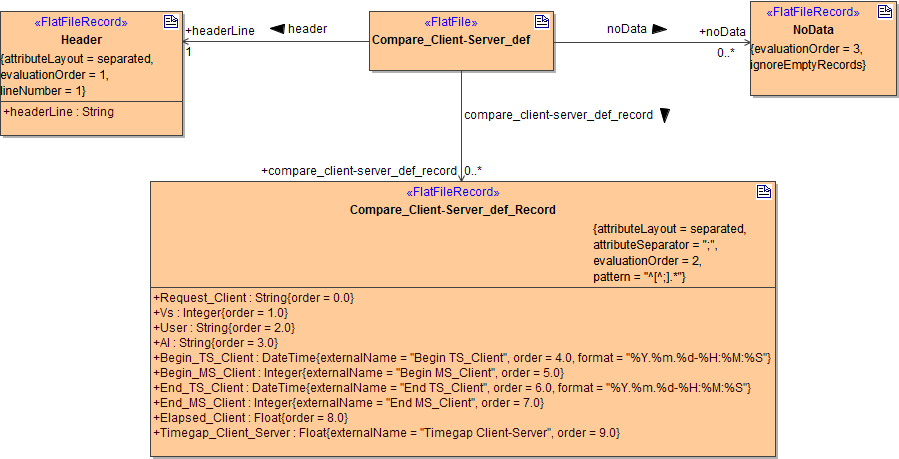
The record structure and the relation between records is defined by one or more child classes and the association to their parent class (e.g. the root class or a parent record class). All records have stereotype <<FlatFileRecord>>.
Figure: Flat File Record Structure
Flat File Record Groups
Additionally, (virtual) groups can be defined by stereotype <<FlatFileGroup>>. These classes have no physical representation in the flat file itself.
Flat File Record Settings
Find below a list of all tagged values corresponding to the stereotype <<FlatFileRecord>>.
| Tagged Value | Description | Allowed Values | Example | |
|---|---|---|---|---|
| attributeLayout |
Defines the attribute layout (fixed or separated) of the flat file record.
|
fixed | fixed attribute layout |
|
| separated | separated attribute layout | |||
| attributeSeparator | Defines the attribute/field separator. | any character | use this character as attribute separator |
|
| <Tab> | use tabulator as attribute separator | |||
| attributePattern | A RegEx pattern to parse the record content into the attributes using capture groups. | a valid regular expression | ^(.?)(://)([A-Za-z0-9.])(:[0-9])(/.)$ |
|
| evaluationOrder | Defines the order in which the association of the classes starting on same parent class must be processed, see Flat File Adapter Parsing Process. | any integer |
|
|
| ignoreEmptyRecords |
Boolean value for ignoring empty records. If set to true, no item will be generated, if none of the defined attributes or sub records have any content. |
true | ignore empty records |
|
| false (default) | process empty records | |||
| ignoreEmptyStrings |
Boolean value for ignoring empty string attributes. If set to true, empty string values will be processed to |
true | ignore empty string values |
|
| false (default) | preserve empty string values | |||
| lineNumber | Specifies the number of a record in the file. The first record is lineNumber=1, the second lineNumber=2, etc. | any integer |
|
|
| pattern |
A pattern to identify the record. The pattern is checked before the fields are separated. If no pattern is defined, all records will be parsed. |
any character |
|
|
| a valid regular expression | ^Pattern.* |
|||
| suppressEscaping |
Boolean value to suppress escaping. If suppressEscaping on a <<FlatFileRecord>> is true, <<FlatFileComplexAttribute>> that are part of this record will inherit this setting. |
true | attribute values of this record will not be un-escaped (parser) or escaped (composer) |
|
| false | escaping/un-escaping is not suppressed | |||
| parseMacro |
A macro that is executed while parsing/composing a file or complex field. This macro can contain multiple commands separated by commas or spaces. Macros on classes are executed before the processing of its attributes or associations. The ID represents a counter. The following counters are available:
Automatic counters are increased by 1 for each processed record. Custom counters have to be increased manually using the increase macro. All counters have the initial value of 0 when they process the first record. For more details on macro commands see Macro Expressions . |
any valid macro expression (see Macro Expressions) | GetCounter(AUTO0) |
|
| composeMacro | ||||
For detailed information on associations see Defining a Flat File | id (25.1)DefiningaFlatFile FlatFileGroupSettings or Defining a Flat File | id (25.1)DefiningaFlatFile AssociationsEndingsof<<FlatFileRecord>>and<<FlatFileGroup>> .
Flat File Group Settings
You can group multiple records in one virtual structure by using the stereotype <<FlatFileGroup>>. This virtual group does not have a representation in the flat file and therefore cannot hold any attributes. Apart from this, this element has the same behavior like a flat file record. For parsing and composing, the pattern and conditions are checked but no mapping takes place. The record details are given to the associated class where the mapping is done.
Find below a list of all tagged values corresponding to the stereotype <<FlatFileGroup>> .
| Tagged Value | Description | Allowed Values | Example | |
|---|---|---|---|---|
| pattern |
The excerpt 'pattern' was not found in the space 'BRIDGE' or you may not have the necessary permissions to access it. If you're experiencing issues please see our Troubleshooting Guide. |
any character | ^Pattern.* |
|
| a valid regular expression | ||||
Associations Endings of <<FlatFileRecord>> and <<FlatFileGroup>>
All associations ending on a class with stereotype <<FlatFileRecord>> or <<FlatFileGroup>> can have additional attributes, if the association end has stereotype <<FlatFileSubRecord>> applied.
Find below a list of all tagged values corresponding to stereotype <<FlatFileSubRecord>> .
| Tagged Value | Description | Allowed Values | Example | |
|---|---|---|---|---|
| condition | A condition that must evaluate true if the record exists. The condition can refer to a self object which represents the current state of the parent. | any valid conditional expression | self.UNS.exists() |
|
| evaluationOrder | Defines the order in which the associations starting on same parent class must be processed, see Flat File Adapter Parsing Process. | any integer |
|
|
| offset | Define the position of this record in the flat file, starting with 0 for the first record and always relative to the parent element. | any integer |
|
|
Defining Flat File Record Attributes
All Attributes on a <<Flat File Record>> class need to have stereotype <<FlatFileAttribute>>. Depending on the layout type of the flat file (fixed or separated), you can specify different tagged values (see Defining a Flat File | id (25.1)DefiningaFlatFile AttributeSettingsforattributeLayout=fixed and Defining a Flat File | id (25.1)DefiningaFlatFile AttributeSettingsforattributeLayout=separated). Additionally, you can define record fields as to be of complex type (see Defining a Flat File | id (25.1)DefiningaFlatFile ComplexFlatFileRecordAttributes).
Attribute Settings for attributeLayout = fixed
For flat files having a fixed layout, you need to specify external length and order of the attribute, and optionally, you can specify a padding.
| Tagged Value | Description | Allowed Values | Example | |
|---|---|---|---|---|
| decimals | Replaced by format.
|
|
|
|
| externalLength | Number of characters of the field (only for fixed length records relevant). | any integer |
|
|
| format |
Pattern for formatting numeric and date & time values. For details see Number Formatting respectively Date and Time Formatting. |
any valid number or dateTime pattern | S9G999G990D00
%Y.%m.%d-%H:%M:% |
|
| nativeTyp deprecated | Replaced by format. |
|
|
|
| order | The evaluation order of the attributes. If offset is not used, order reflects the field number within the record. | any integer |
|
|
| offset | The character position of this field within the record. | any integer |
|
|
| padding | Defines the padding rule for the field. When parsing, the characters on the left or right side are ignored up to the first different character. When composing, the field is filled on the left or right side with the specified character. | left("<any character>") | left("0") |
|
| right("<any character>") | right(" ") |
|||
| suppressEscaping |
Boolean value to suppress escaping. |
true | attribute values of this attribute will not be un-escaped (parser) or escaped (composer) |
|
| false | escaping/un-escaping is not suppressed | |||
| parseMacro |
The excerpt 'macro' was not found in the space 'BRIDGE' or you may not have the necessary permissions to access it. If you're experiencing issues please see our Troubleshooting Guide. |
any valid macro expression (see Macro Expressions) | GetCounter(0) |
|
| composeMacro | ||||
Attribute Settings for attributeLayout = separated
For attributes in separated flat files, you can supply an offset to specify the position of the field (attribute) in respect of the other record fields.
| Tagged Value | Description | Allowed Values | Example | |
|---|---|---|---|---|
| format |
The excerpt 'format' was not found in the space 'BRIDGE' or you may not have the necessary permissions to access it. If you're experiencing issues please see our Troubleshooting Guide. |
|
|
|
| order | The evaluation order of the attributes. If offset is not used, order reflects the field number within the record. | any integer | ||
| offset | The relative position of the field in respect of the other fields in the record, e.g. field number 3 has offset = 2. | any integer |
|
|
| suppressEscaping |
The excerpt 'suppressEscaping' was not found in the space 'BRIDGE' or you may not have the necessary permissions to access it. If you're experiencing issues please see our Troubleshooting Guide. |
|
|
|
| parseMacro |
The excerpt 'macro' was not found in the space 'BRIDGE' or you may not have the necessary permissions to access it. If you're experiencing issues please see our Troubleshooting Guide. |
any valid macro expression (see Macro Expressions) | GetCounter(0) |
|
| composeMacro | ||||
Complex Flat File Record Attributes
Flat file record attributes can by of complex type. The complex type must have stereotype <<FlatFileComplexAttribute>> applied, then.
Figure: Flat File Complex Attribute
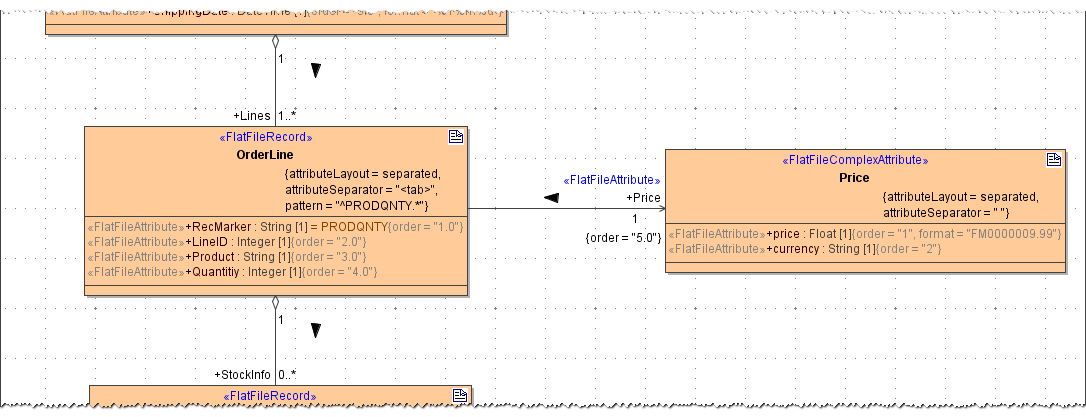
You can use this class to divide a record field into sub-fields. You can think of this like a <<FlatFileRecord>> placed within a single field. Most of the tagged values that are valid for a flat file record are valid for a complex attribute, too. Though, the scope of these settings is not the record, but the field.
| Tagged Value | Description | Allowed Values | Example | |
|---|---|---|---|---|
| attributeLayout |
Defines the attribute layout (fixed or separated) of the complex attribute.
|
fixed | fixed attribute layout |
|
| separated | separated attribute layout |
|
||
| attributeSeparator | Defines the attribute/field separator. | any character | use this character as attribute separator |
|
| <Tab> | use tabulator as attribute separator |
|
||
| attributePattern | A RegEx pattern to parse the field content into a complex structure using capture groups. | a valid regular expression | ^(.?)(://)([A-Za-z0-9.])(:[0-9])(/.)$ |
|
| suppressEscaping |
Boolean value to suppress escaping. |
true | attribute values of this attribute will not be un-escaped (parser) or escaped (composer) |
|
| false | escaping/un-escaping is not suppressed | |||
| parseMacro |
The excerpt 'macro' was not found in the space 'BRIDGE' or you may not have the necessary permissions to access it. If you're experiencing issues please see our Troubleshooting Guide. |
any valid macro expression (see Macro Expressions) | GetCounter(0) |
|
| composeMacro | ||||
Macro Expressions
Available macros are counters:
-
eight automatic counters with ID
AUTO0..AUTO7(for parsing and composing) -
two automatic line counters with ID
LINE0andLINE1(for parsing only) -
unlimited custom counters with ID
CUSTOM0..CUSTOMx(for parsing and composing).
Automatic counters automatically increase with each processed record, whereas custom counters have to be increased manually using the IncreaseCounter() macro. When parsing/composing the first record, all counters have the initial value of 0.
|
Macro |
Available on |
Available
|
Description |
Example |
|---|---|---|---|---|
|
ResetCounter( |
Classes
|
|
Reset the counter |
ResetCounter(AUTO0, 1) |
|
IncreaseCounter( |
Classes
|
|
Increases the counter |
IncreaseCounter(CUSTOM2) |
|
GetCounter( |
Attributes |
|
Read the value of a counter and store it in the current attribute. |
GetCounter(LINE0) |
|
VerifyCounter( |
Attributes |
|
Compare the value of a counter with the current attribute. This macro will throw an exception if the values are not equal. |
VerifyCounter(CUSTOM0) |
For GetCounter() and VerifyCounter() only attributes of type Integer are supported.