
|
|
<your example path>\Basic Modeling\Data\uml\constructors.xml |

Declaring Constructors
A constructor "initializes" an object. Each time an objects gets created, its constructor is called. The constructor then executes its duties like setting initial values or even processing complex operations.
A create statement creates an object by invoking its constructor. Object fields are guaranteed to be initialized to their default values when the constructor is called. If no user-defined default constructor exists, an empty constructor will be implicitly created. The implicit default constructor does nothing. The default constructor is a constructor that can be called without parameters (it has no parameters or all its parameters have default values).
Each constructor initializes its part of the final class. Each super class's constructor is guaranteed to be executed first, before the constructor of the child class gets executed. By default, a default constructor of the parent is implicitly run. One can however influence this and replace the implicit call by an explicit call as described in .
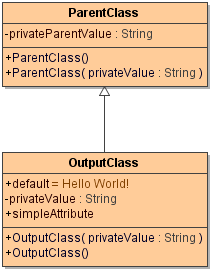
User-defined constructors are operations having the same name as the owning class. For example, the classes ParentClass and OutputClass contain four explicitly defined constructors: ParentClass(), ParentClass(privateValue:String) respectively OutputClass(), OutputClass(privateValue:String):
Example: Creating Objects
|
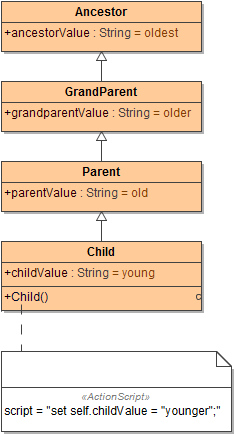
The statement creates the following object: aChildObject { ancestorValue:"oldest", grandparentValue:"older", parentValue:"old", childValue:"young" }
The statement creates the following object: aChildObject { ancestorValue:"oldest", grandparentValue:"older", parentValue:"old", childValue:"younger" } |
Calling Constructors
Constructors are called if the name of the created object is followed by parentheses:
|
Syntax |
|
|
|---|---|---|
|
Semantics |
Calling a constructor. |
|
|
Substitutables |
|
Any given name. |
|
|
Parameters of the constructor. The compiler will invoke a constructor of the class of |
|
|
Examples |
|
|
Calling Constructors of Super Classes
If a constructor has to call the constructor of its super class explicitly, the keyword super can be used. The super()statement invokes the constructor that is matching parameters of the super()call itself. This call has to happen as the first statement in the first action.
|
Syntax |
|
|
|---|---|---|
|
Semantics |
Calling a constructor of the super (parent) class. |
|
|
|
|
Parameters of the constructor. The compiler will then invoke a constructor of the class of |
|
Examples |
|
|