Attributes Panel
Overview
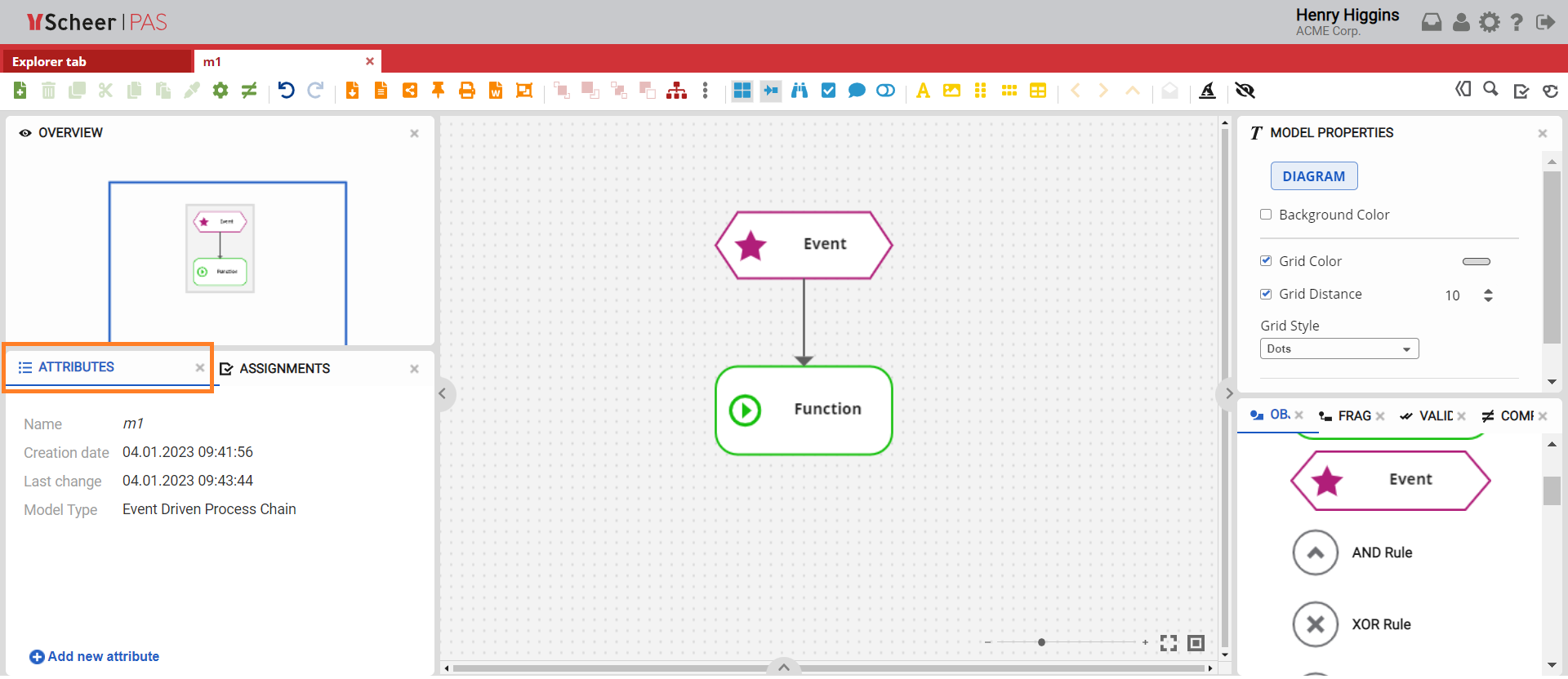
The Attributes panel is used to view, create, edit, and remove attributes for models and objects. It allows users to maintain descriptive and technical information such as names, identifiers, dates, or classifications.
By default, the Attributes panel is displayed on the left side of the Canvas.
Both models and objects can have attributes. To display the attributes of a model, click on an empty area of the Canvas. The model attributes are then listed in the Attributes panel. To display the attributes of an object, click on the corresponding object on the Canvas. The attributes of the selected object are shown in the Attributes panel.
Adding a New Attribute
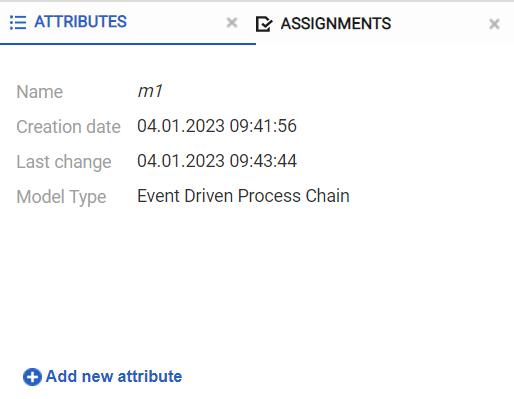
New attributes can be added using the Add Attribute button located in the lower-left area of the Attributes panel. When creating an attribute, a name must be provided and an attribute type selected.
Attributes are reusable and can be applied across multiple models or objects. While entering the attribute name, the system displays suggestions of existing attributes, allowing users to select and reuse an attribute instead of creating a new one. This helps avoid duplicate attributes and ensures consistent attribute usage.
Note: A reused attribute is the same attribute, not a copy. Changes to the attribute definition apply in each Model/Object the attribute is used.
Attribute Types Overview
The following attribute types are available:
-
Text - Stores a single line of plain text.
-
Rich Text - Stores formatted text and supports basic text styling.
-
Date - Stores a calendar date without time information.
-
Date/Time - Stores a date including time information.
-
Number - Stores numeric values.
-
Select - Allows selection of a single value from a predefined list of options.
-
Multiselect - Allows selection of multiple values from a predefined list of options.
-
Link - Stores a hyperlink or reference to an external resource.
-
User Type - Stores a reference to a user or user-related entity.
Creating new attributes is only possible if this option is enabled in the PAS Administration under System Configuration otherwise just PAS Administrators are able to create new attributes.
Editing Attributes
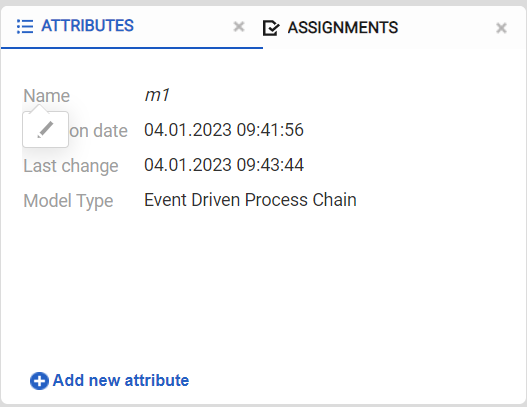
To edit an existing attribute, right-click the attribute name in the Attributes panel. A context menu is displayed. Select Edit Attribute Name to open the attribute editing dialog, where the attribute name can be modified and saved.
Attributes of the types Number, Select, and Multiselect provide an additional option Edit Attribute Select Options. This option allows the modification of selectable values. Detailed information about configuring attribute options is described in the corresponding attribute-specific sections of this documentation.
Warning: Changes made to an attribute, such as renaming the attribute or modifying its options, apply globally. The changes affect all models and objects that use this attribute.
Attributes can be removed by hovering over the attribute in the Attributes panel and clicking the X icon that appears next to it. Only attributes that were created for the currently selected element can be removed.
Occurrence-Specific Attributes
If an occurrence requires its own attribute value that differs from the definition, an occurrence-specific attribute can be created. This allows a local value to override the value defined at the definition level.
Occurrence-specific attributes are useful in scenarios where shared objects require contextual values, such as transaction codes within a specific process.
Using Attributes on the Canvas
Attributes of models or objects can be dragged and dropped directly onto the Canvas. When an attribute is placed on the Canvas, it becomes part of the visual model representation.
Dragged attributes are also listed in the Model-Object Properties panel, where their display and behavior can be further configured.
For more information, see the Model-Object Properties section of the documentation.