
All available services are displayed in the list on the administration start page.
The number of available services is displayed in the footer:
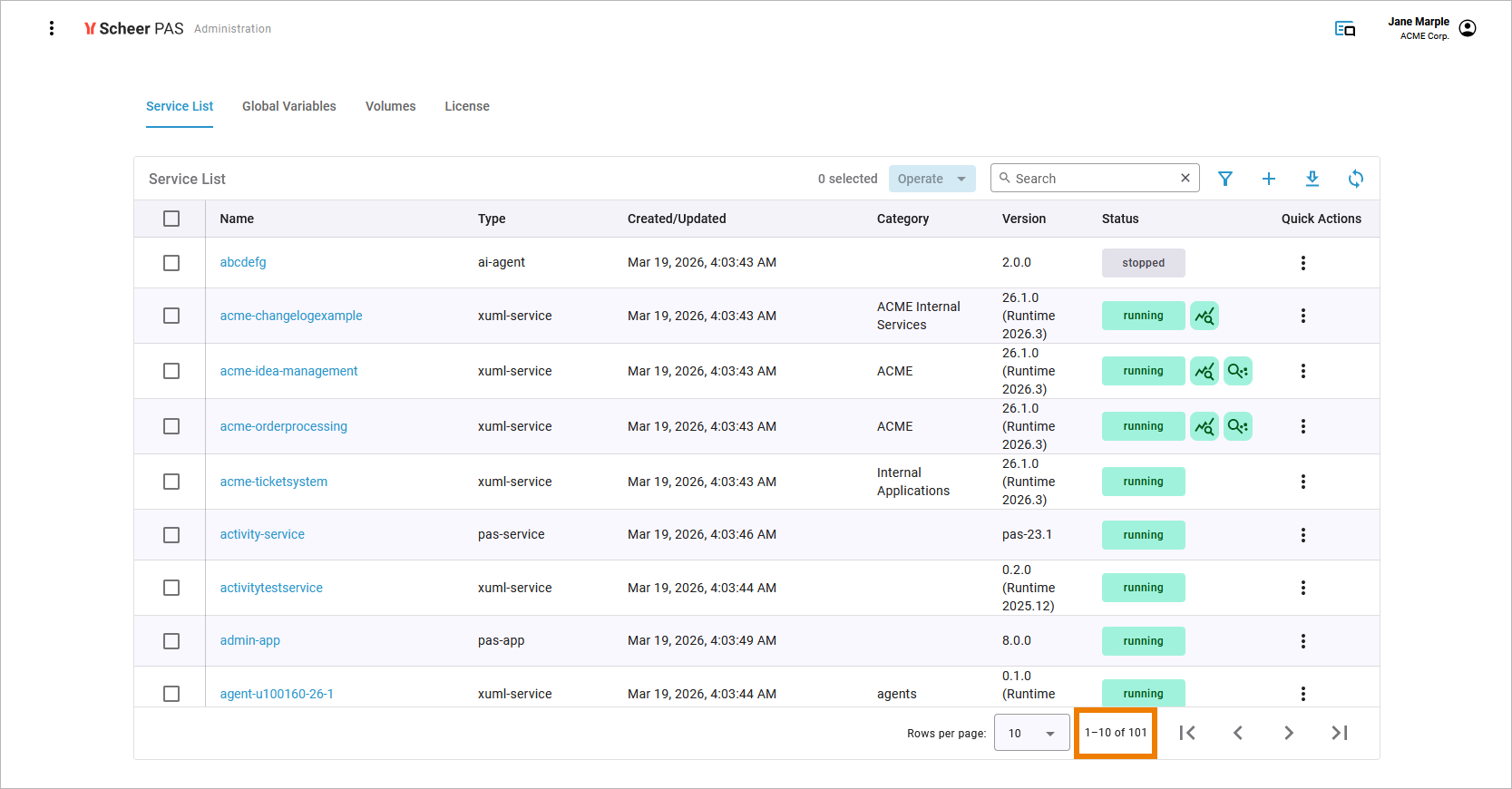
Click on a service name to access the service details. For detailed information about the service details, refer to Docker Setup or Kubernetes Setup depending on the installation of your PAS system.
We recommend using container deployment as the default deployment target starting with PAS 23.1. For further information see:
In the navigation bar of the administration, you can find the following tabs:
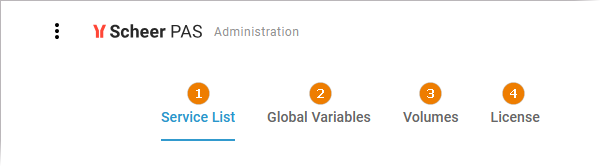
Please note that some tabs are only available on Kubernetes systems.
|
Tab |
Description |
|---|---|
|
(1) Service List |
Opens the list of services that are running on your platform. The content displayed to you depends on which profiles are assigned to your user:
Refer to Overview of Standard Profiles for more details. |
|
(2) Global Variables |
Opens the global variables view. Refer to Managing Global Variables for Containerized xUML Services for details. [1] Not available on Docker setups. [1] |
|
(3) Volumes |
Opens the volumes management. Refer to Connecting External Volumes for details. [1] Not available on Docker setups. [1] |
|
(4) License |
Opens detailed license information. |
Working With the Service List
The service list is displayed by default if you open the administration. On top of the service list, you can find multiple options:

|
UI Element |
Name |
Description |
|---|---|---|

|
Number of Selected Services |
You can use the checkboxes in the first column of the list to select one or more services. The number of selected services is displayed here. |

|
Operate |
Use this option to apply an action to all selected services. Available options are:
This option can only be used if one or more services have been selected from the list. |

|
Search |
Enter your search term(s) to filter the list of services.
|

|
Extended Filter |
Opens the extended filter.
|

|
Deployment Wizard |
Opens the deployment wizard.
|

|
Export Service List |
Downloads the content of the service list as Excel list. |

|
Reload Service List
|
Refreshes the list of services. |
Managing Services
The service list shows all services that are available on the platform and that your user is allowed to see according to his user rights (refer to Overview of Standard Profiles for details):
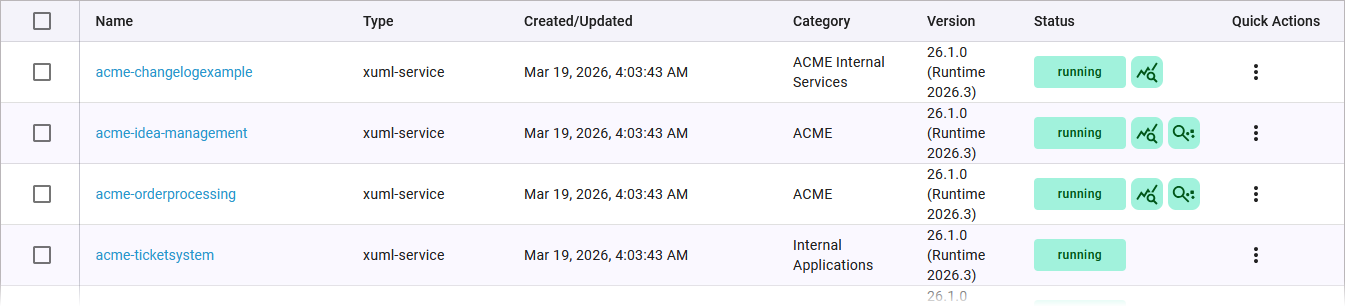
The list contains the following information:
|
Column Name |
Description |
Possible Values
|
Possible Values
|
Possible Values
|
|---|---|---|---|---|
|
Name |
Name of the service. Click on the name to access the service details page. |
any string |
||
|
Type |
Indicates the type of the service. What is the difference between pas-app and pas-service?
|
Other service types may be displayed. |
|
Other service types may be displayed. |
|
Created/Updated |
Shows the date and time of the last update of the service. If the service has not been updated yet, its creation date is displayed. |
Datetime in format dd.mm.yyyy, hh:mm:ss |
||
|
Category |
Displays the category of the service as specified by its creator.For services running in the integration component, the displayed category is always bridge. |
any string |
bridge |
any string |
|
Version |
|
any string
|
any string
|
any string |
|
Status |
Indicates the status of the service. Container of type init should always be in status exited.
On PAS systems running on Kubernetes, the status is continously updated without refreshing the page. [1]
|
The color of the label indicates the following:
|
||
|
Indicates whether the logging for Process Mining is enabled. [1] |
- |
- |

|
|
|
Indicates whether tracing is enabled for a service in the Analyzer . |

|
- |
|
|
|
Quick Actions |
||||
Quick Actions
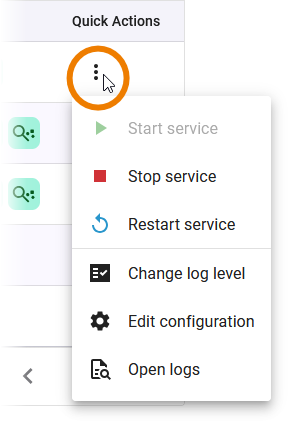
In the last column of the service list, you will find quick actions for each service. They grant direct access to the applicable actions for this service:
|
Icon |
Description |
|---|---|

|
Click Start service to start the service. |

|
Click Stop service to stop the service. |

|
Click Restart service to restart the service. |

|
Click Change log level to change the log level.
For further details in a Docker setup, refer to: For further details in a Kubernetes setup, refer to: |

|
Click Edit configuration to change the service configuration.
For further details in a Docker setup, refer to: For further details in a Kubernetes setup, refer to: |

|
Click Open logs to access the service logs.
For further details about log analysis refer to Analyzing Logs. For further details in a Docker setup, refer to: For further details in a Kubernetes setup, refer to: |
Filtering the Service List
Use the filter field to search for a specific service. The content of the filter field is applied to the columns Name, Type and Category:
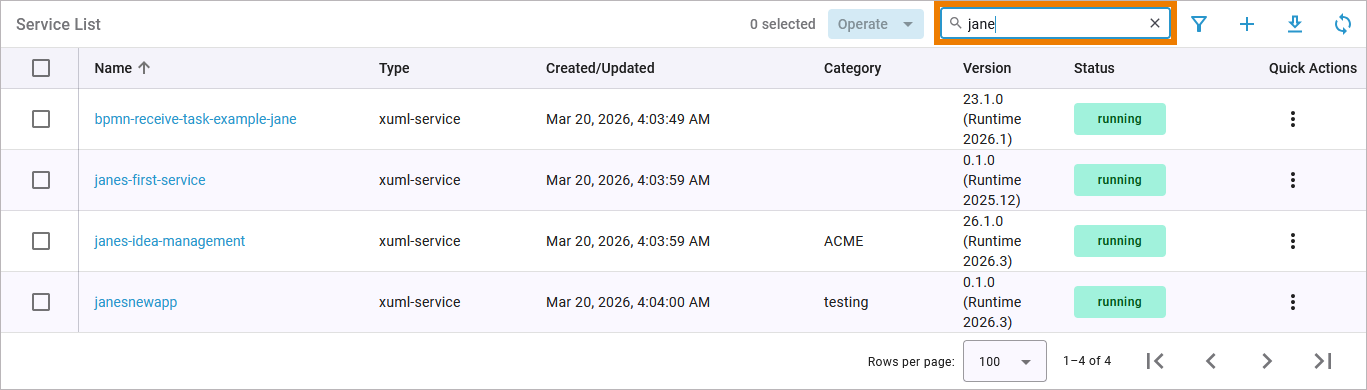
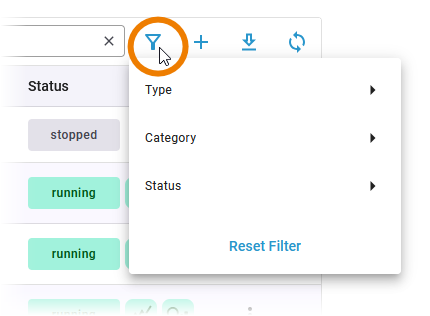
Use the Extended Filter to display the extended filter options:
-
Type
-
Category
-
Status
-
Reset Filter
|
Source |
Docker |
Kubernetes |
Integration (Bridge) |
|---|---|---|---|
|
Type |
Other service types may be displayed. |
Other service types may be displayed. |
|
|
Status |
|
Various error states may be displayed, refer to Handling Workload Errors for an overview on all errors and possible solutions. |
|
|
The status filter displays only the statuses that services are currently in. |
|||
The extended filter allows you to select multiple types and states. The number of applied filters is displayed next to the filter option. The extended filter displays 10 options at once. Use the navigation at the bottom to see more options:
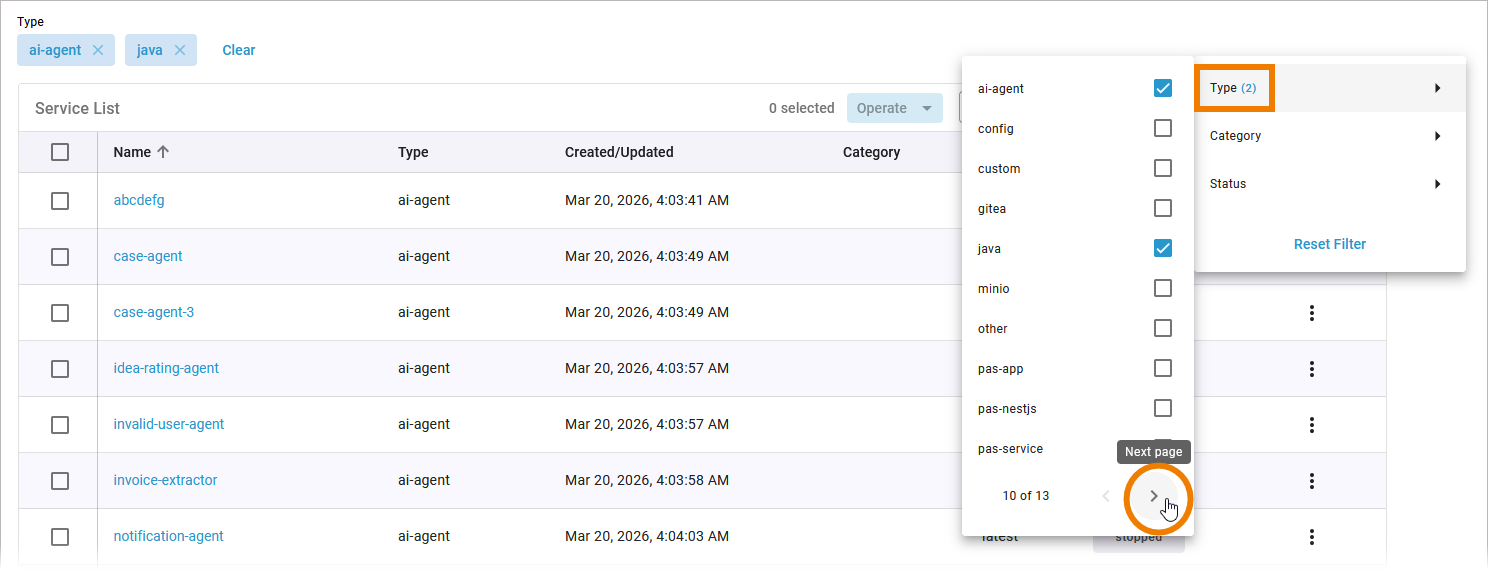
If a filter is applied, the Extended Filter image changes and the applied filters are displayed in blue above the service list:
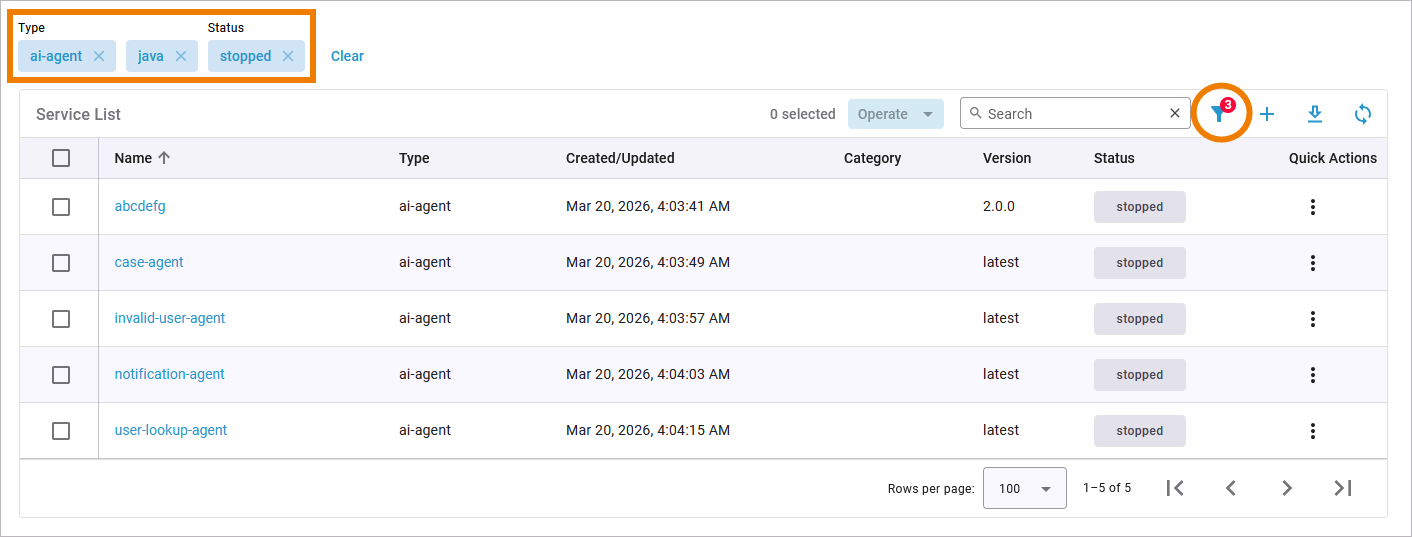
You have multiple options to reset a filter:
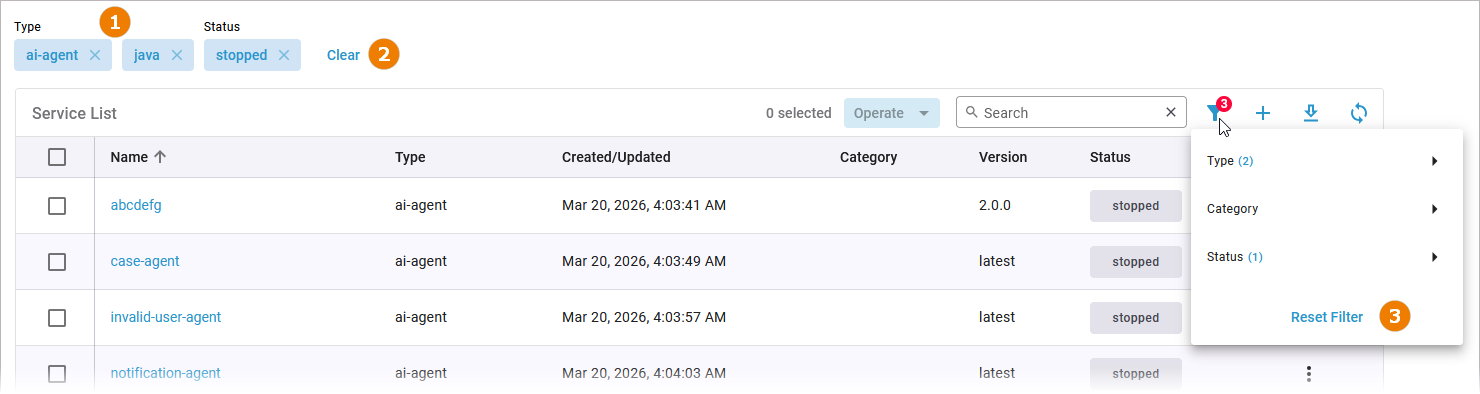
(1) Use the X in a filter label.
(2) Use Clear next to the filter labels.
(3) Use Reset Filter in the extended filter window.
Sorting the Service List
You can sort the contents of the service list. Hover over the column name you want to sort by (all columns except Quick Actions are sortable):
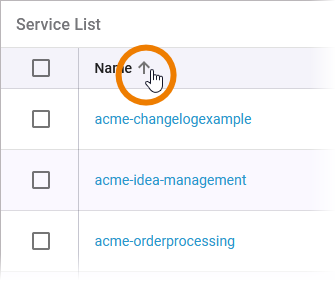
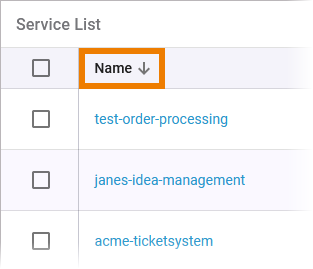
The content is sorted according to the selected column. In addition, an arrow appears in the top column, indicating whether the data has been sorted in an ascending or descending order. Click again to change the direction.
-
First click: Ascending order
-
Second click: Descending order
-
Third click: Ordering disabled
Viewing License Information
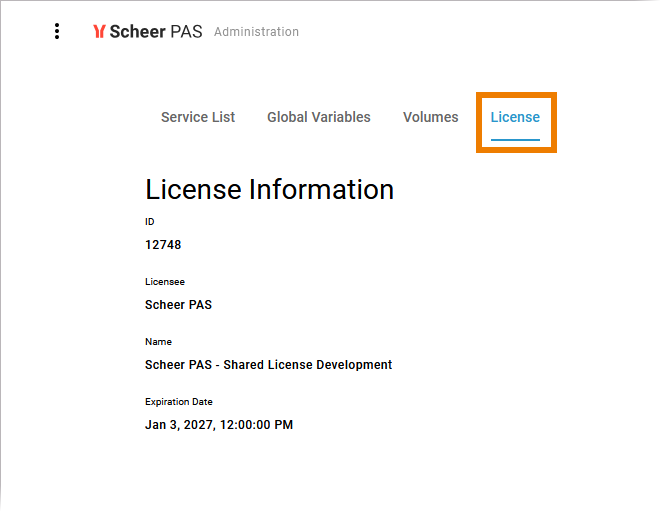
If you want to inspect detailed information about the license of your PAS installation, click the License tab in the navigation bar:
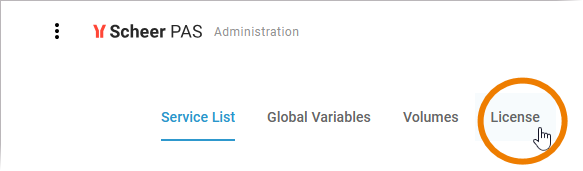
The license information is read-only and shows the following:
-
License ID
-
Licensee
-
License Name
-
Expiration Date
Footnotes
Differences between Docker and Kubernetes
Customers can run Scheer PAS on a Docker or a Kubernetes setup.
If the behavior of Kubernetes and Docker differs, we highlight the text in different colors to clarify the differences:
-
Kubernetes-related text is highlighted in green.
-
Docker-related text is highlighted in blue.