
The Control Hub uses status values and badges to tell you the state of a project deployment, of a component deployment, and of a project version. This page is the reference for these values.
Deployment and Component Status
A deployment reports one of the following statuses:
|
Status |
Description |
|---|---|
|
started |
All component deployments are running. |
|
starting |
The deployment is starting up. |
|
stopped |
The deployment is not running. |
|
multiple |
The component deployments are in different states, for example some started and some stopped. The multiple status applies to a project deployment as a whole. It indicates that the component deployments currently have different statuses. |
|
updating |
The deployment is being updated to another version. The platform has not finished replacing what the deployment runs. |
|
degraded |
The deployment update has stalled and will not be completed until you take action. The version to be replaced is still running. |
|
unknown |
The Control Hub cannot determine the state of the deployment. A project deployment without component deployments reports this status as well. |
|
failed |
The deployment has failed and is in an error state. |
While a project or component deployment is starting, its indicator is animated.
You can filter the Deployments view by these status values. Refer to Working With the Control Hub for detailed information about filtering in the Control Hub.
Status Display
The status is displayed in the following places:
|
Location |
Indicator |
|---|---|
|
Status column of the Deployments view Status column of the Agents view |
A colored label with the status: 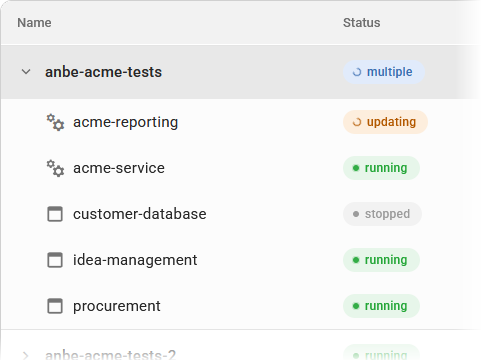
|
|
Deployment details page (header) |
A colored label with the status of the whole deployment: 
|
|
Component list of the deployment panel |
A colored dot per component deployment: 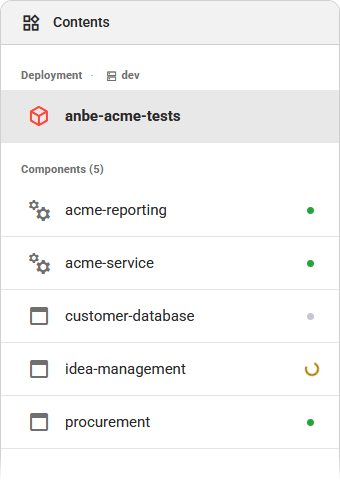
|
|
Deployments tab of the project details view |
The status of each existing deployment of the project: 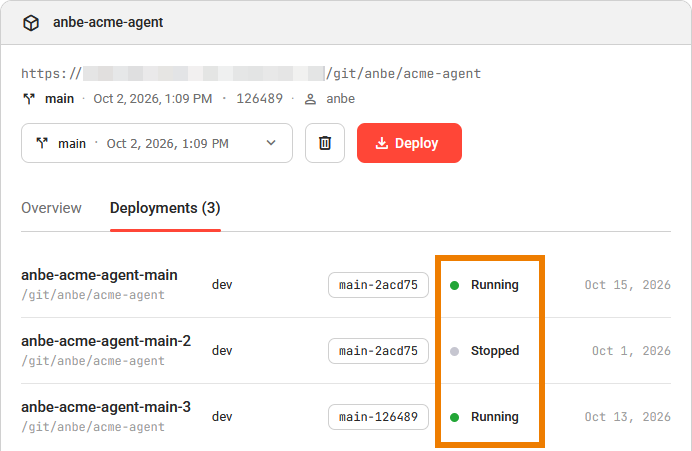
|
How a Project Status Is Derived
A project deployment has no status of its own. It derives its status from the statuses of its component deployments. When all component deployments report the same status, the project deployment reports that status.
|
Status |
Description |
|---|---|
|
started |
A project deployment whose components are all running reports started. |
|
multiple |
When the component deployments report different statuses, the project deployment reports multiple. |
|
stopped |
A project deployment without components or with all component deployments stopped reports stopped. |
|
failed |
When the state of a component deployment cannot be determined, the component reports failed. |
Refer to Working With the Deployments View for details.
Status of a Configuration That Cannot Be Applied
A configuration change that the platform accepted but cannot apply is a condition of the deployment itself:
-
A component deployment whose configuration cannot be applied reports failed, whatever condition the component itself is in. A component that still runs on its previous configuration is therefore not shown as running.
-
A project deployment whose own project-level configuration cannot be applied reports failed, whatever its component deployments report.
-
Exception: a stopped component deployment reports stopped, also when its configuration cannot be applied. A project deployment whose component deployments are all stopped reports stopped as well. The deployment reports failed again once it is started.
Refer to Configuring a Deployment > Result of a Configuration Change for the notifications that report such a change.
Status and Available Actions
Which lifecycle actions you can use depends on the current status.
|
Project/Component Status |
Available Actions |
|---|---|
|
started |
Restart, Stop |
|
starting |
Stop |
|
stopped |
Start |
|
multiple |
Start, Restart, Stop The multiple status applies to a project deployment as a whole. It indicates that the component deployments currently have different statuses. |
|
failed |
Start, Restart, Stop |
An action that does not apply to the current status is disabled. Delete is available in every status. Refer to Deleting a Deployment for further details.
A deployment that is shown as failed only because its configuration cannot be applied offers the actions of the condition that its components are in. For example, a component deployment that runs offers Restart and Stop, but no Start.
Refer to Operating a Deployment for details on the lifecycle actions and to Deleting a Deployment for details on the delete action.
Agent Status
An agent shows the status of the component deployment that runs it: running, starting, stopped, updating, degraded, failed, or unknown, as described above.
An agent calls an LLM through the Agent Gateway with a virtual API Key. When the model access of a running agent is incomplete or overridden by the configuration, the agent shows one of the following statuses instead of running:
|
Status |
Description |
|---|---|
|
API Key missing |
The agent has no virtual API Key, or its virtual API Key does not exist on the platform, and the configuration of its component deployment sets no own API Key for it. |
|
Model missing |
The agent has no model, and the provider of its virtual API Key has no default model. |
|
Config conflict |
The configuration of the component deployment overrides the virtual API Key of the agent, its model, or both. The agent calls the LLM with the values of the configuration. The label has the colors of degraded. |
-
An agent that does not run shows the status of its deployment, for example stopped.
-
An agent without a virtual API Key shows API Key missing, unless the configuration of its component deployment sets an own API Key for it.
-
You can filter the Agents view by these statuses. Refer to Working With the Agents View for details.
To correct API Key missing or Model missing, change the model access of the agent on its details page. Refer to Working With the Agent Details for details.
To correct Config conflict, remove the value in the configuration of the component deployment, or the virtual API Key and the model of the agent. Refer to What is an Agent? for details.