
Monitoring a Docker Container
All available services are displayed in the list on the administration start page. The list of services will help you to check the details for a container at first sight:
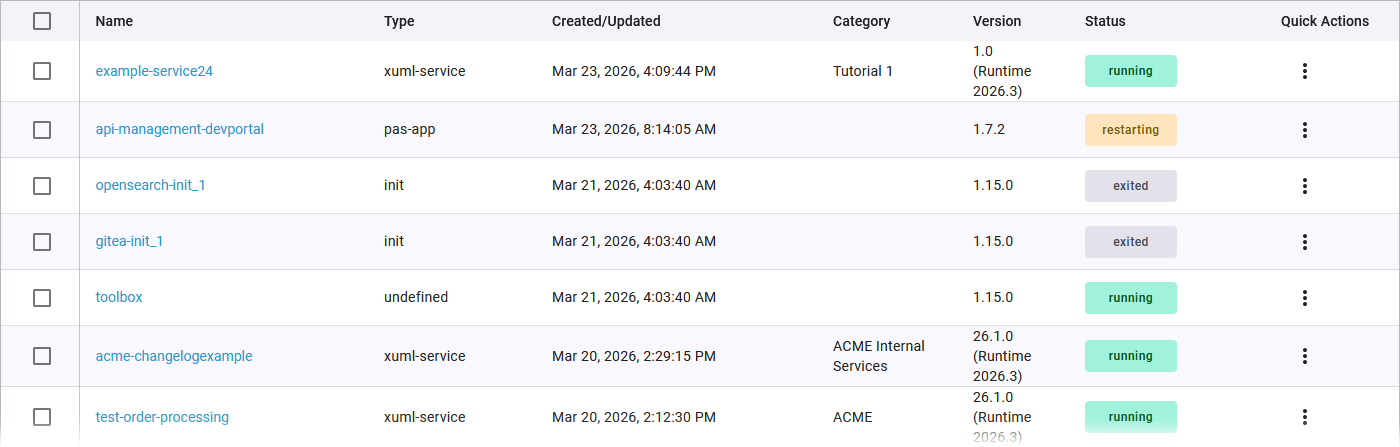
You can identify services running in the PAS integration component by the bridge category. Refer to chapter Controlling Integration Services for details.
For each container, the list shows the following information:
|
Column Name |
Description |
Possible Values |
|---|---|---|
|
Name |
Name of the service. Click on the name to access the service details page. |
any string |
|
Type |
Indicates the type of the service. Services of the xuml-service type have some special features, refer to chapter Controlling Containerized xUML Services (Docker) for all details. Services of the xUML type are running in the integration component, refer to chapter Controlling Integration Services for all details. What is the difference between pas-app and pas-service?
|
Other service types may be displayed. |
|
Created/Updated |
Shows the date and time of the last update of the service. If the service has not been updated yet, its creation date is displayed. |
Datetime in format dd.mm.yyyy, hh:mm:ss |
|
Category |
Displays the category of the service as specified by its creator. For services running in the integration component, the displayed category is always bridge. |
any string |
|
Version |
Version tag of the Docker container.
|
any string |
|
Status |
Indicates the status of the service. Container of type init should always be in status exited. |
The color of the label indicates the following:
|
|
Quick Actions |
||
Starting and Stopping a Docker Container
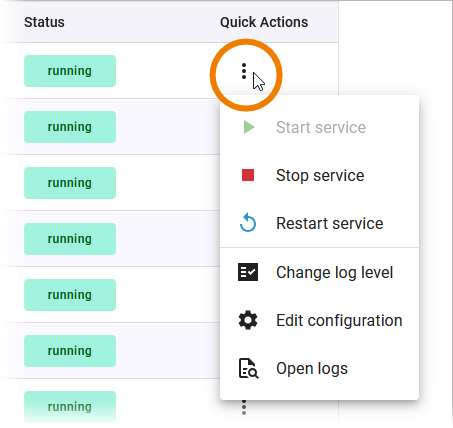
In the last column of the service list, you will find quick actions for each service. They grant direct access to the applicable actions for this service:
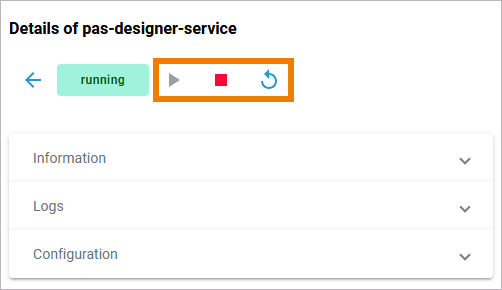
The quick actions for starting, stopping, and restarting a service are also displayed in the header of each details page:
|
Icon |
Description |
|---|---|

|
Start a container, that is currently stopped. |

|
Stop a running container. |

|
Stop a running container and restart it. |
Only applicable actions are enabled.
Using the Container Details
You can open a details page for each container. To do so, click on the service name in the list:

The details page of a service shows you the title of the service and some quick actions:
|
Icon |
Description |
|---|---|

|
Indicates the current state of the service. |

|
Indicates whether tracing is enabled for a service in the Analyzer. |

|
Starts the service. |

|
Stops the service. |

|
Restarts the service. |
It also contains multiple collapsable sections:
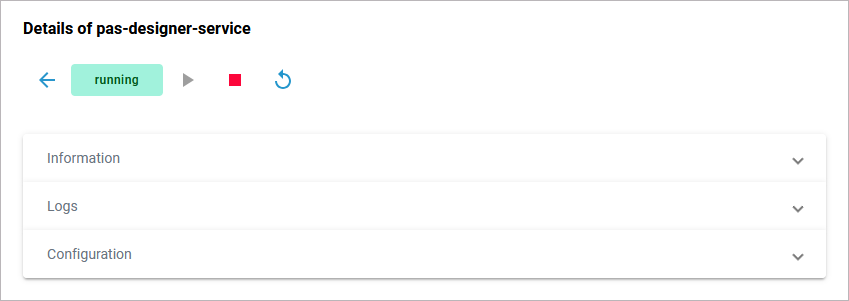
Refer to Controlling Containerized xUML Services (Docker) for an overview on the available details of a containerized xUML service.
Information
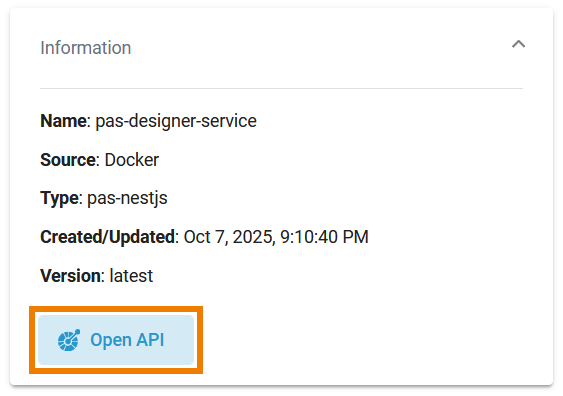
The Information section contains the main information about the container:
-
Name
-
Source is Docker for Docker containers
-
Type
-
Created/Updated
-
Version
For services of type pas-nestjs, the information section also contains the button Open API. Use it to switch to the service API:
Logs
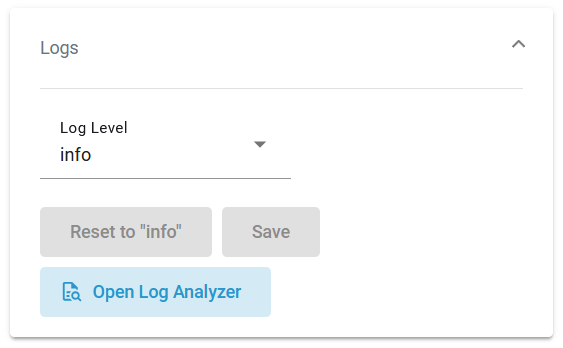
In section Logs you can change the log level. Refer to Changing the Log Level of a Docker Container for detailed information.
The button Open Log Analzyer gives you direct access to the log analyzer, where you can inspect the logs. Refer to Showing Docker Container Logs and Analyzing Logs for further information.
It is also possible that no logs are avilable for a service type. If this is the case, this is also indicated:
Configuration
In the Docker setup, it is only possible to modify configuration files in the Configuration section for the following service types:
-
services running in the integration component (service types xUML and NodeJs)
For all other service types, no configuration settings are available:
Configuring Services of Type “pas-service”
For services of type pas-service a JSON editor is displayed (refer to Adapting Docker Container Configuration for detailed information):
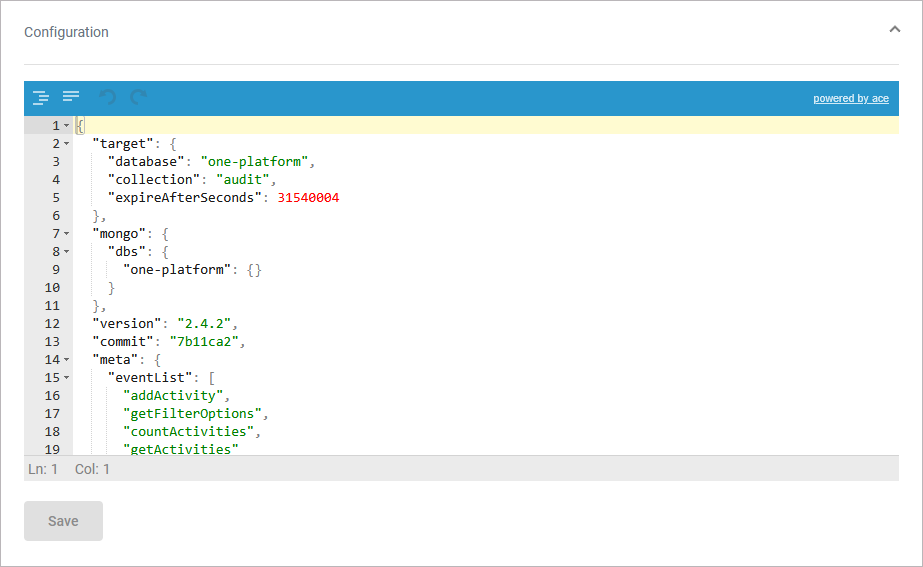
Do not edit content in the Configuration section without any knowledge of JSON.
Configuring Services of Type “pas-nestjs”
For services of type pas-nestjs (= internal services of the PAS platform) developers can define a service-specific schema and documentation.
If a schema is available, the display in section Configuration will change and show the defined configuration options (refer to Adapting Docker Container Configuration for detailed information):
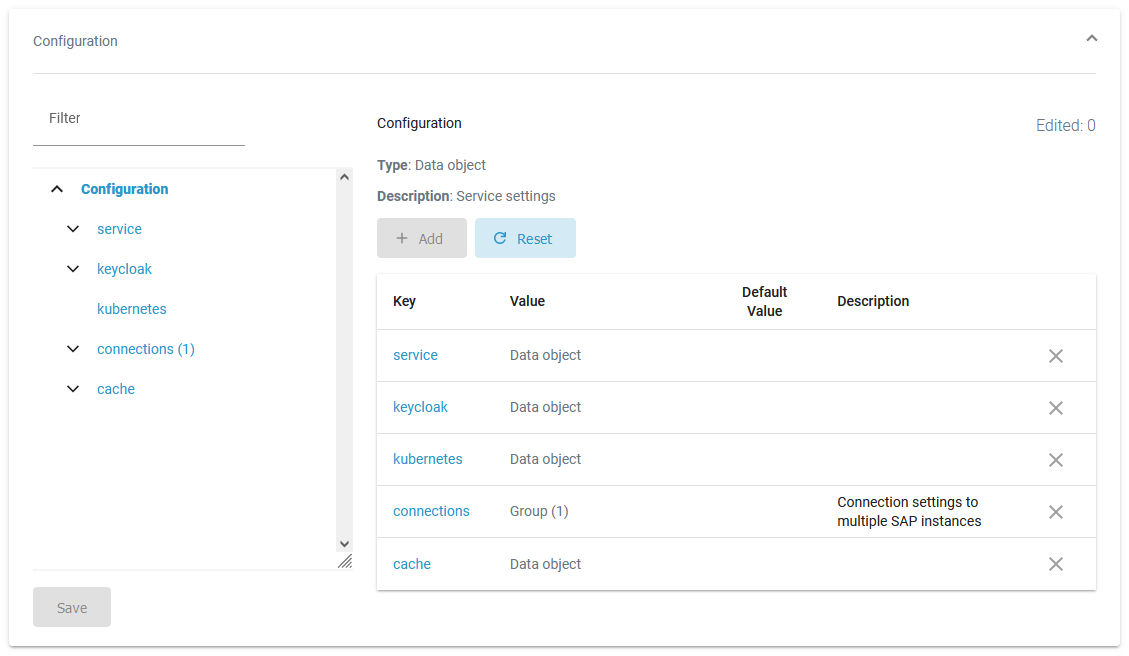
If no schema is available, a JSON editor is displayed in section Configuration:
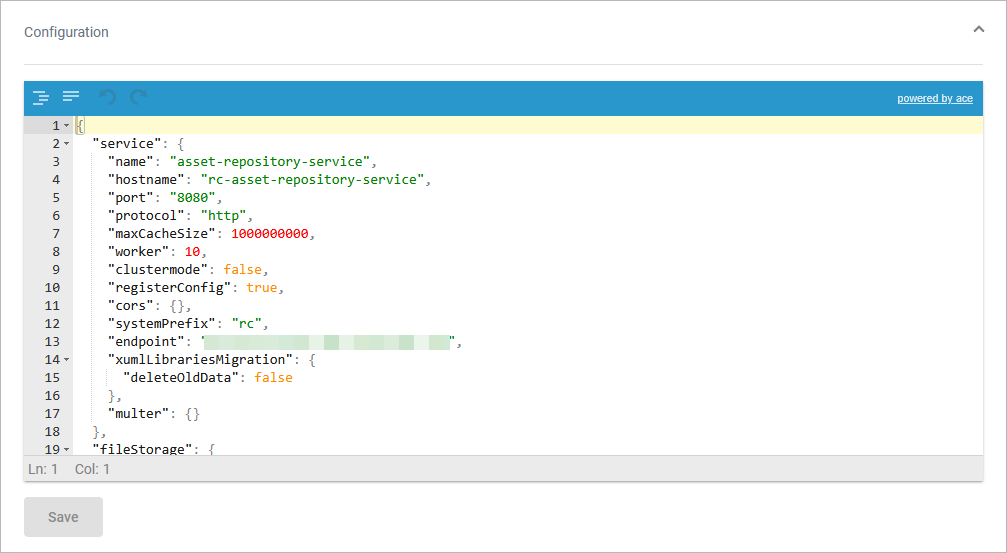
Do not edit content in the Configuration section without any knowledge of JSON.
Configuring Services of Type “xuml-service”
For an overview of all configuration settings of an xuml-service, refer to Controlling Containerized xUML Services (Docker).
Configuring Services of Type “xUML” and “NodeJs”
For an overview of all configuration settings of services running in the PAS integration component, refer to Adapting Integration Service Configuration.